IGP Women’s Initiative and Kent Global Leadership Program Host Virtual Roundtable on Supporting Survivors of Conflict-Related Sexual Violence
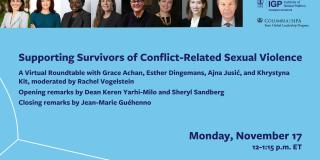
On November 17, the Institute of Global Politics (IGP) Women’s Initiative and Kent Global Leadership Program on Conflict Resolution convened a virtual roundtable to discuss policies and programs to support survivors of conflict-related sexual violence (CRSV). Amidst rising geopolitical instability and record levels of conflict, speakers stressed the need for survivor-centered approaches that restore dignity and improve access to reparations in transitional justice contexts.
Keren Yarhi-Milo, dean of Columbia’s School of International and Public Affairs (SIPA) and Adlai E. Stevenson Professor of International Relations, and Sheryl Sandberg, founder of Lean In and the Sandberg Goldberg Bernthal Family Foundation, delivered opening remarks for the event. Rachel Vogelstein, Director of the IGP Women’s Initiative and associate professor of professional practice at SIPA, moderated the event.
Sandberg described conflict-related sexual violence as a devastating tactic of war that leaves lasting impacts on entire communities. Survivors “are living with deep and lasting scars from South Sudan and the Democratic Republic of the Congo to Syria and Ukraine,” Sandberg emphasized. “People are carrying the trauma of violence and doing the hard, brave work of rebuilding their lives. And we know that this takes a very serious toll. Survivors often face lifelong health challenges, reproductive injuries, infections, [and] chronic pain.” Her words set the stage for a conversation focused on whole-of-society approaches to tackling wartime sexual violence.
Khrystyna Kit, head of JurFem Ukrainian Women Lawyers Association, highlighted legal representation as crucial to survivors. Drawing from her experience advising Ukraine’s “Bardina Law,” a groundbreaking reparations system, Kit emphasized the importance of “building a response system [and] ensuring a victim-oriented approach” with minimum standards of support and assistance. “If we cannot guarantee reparations for survivors of conflict-related sexual violence, we cannot guarantee justice,” she said.
Ensuring reparations through policy, panelists noted, must also extend to children born of wartime rape, who often face deep emotional, social, and identity-related challenges. Ajna Jusić, president of Forgotten Children of War, reflected on her successful campaign to have these children recognized as a distinct category of victims in Bosnia - a landmark acknowledgment enshrined in a law passed in 2022, nearly thirty years after the war ended. As Jusić explained, “in many post-conflict zones, children are neglected and rejected by the family” due to the circumstances of their birth. Formal recognition, she said, signals that “the state finally sees you,” giving children protection from discrimination and creating equitable opportunities.
Beyond legal approaches, panelists also underscored the necessity of co-creating laws with survivors of sexual violence. Grace Achan, cofounder of the Women’s Advocacy Network, noted that “including survivors in policymaking is a source of ownership,” enabling them to “identify their exact needs, allow their voices to be heard, and feel valued.” Survivors’ involvement, Achan added, should continue through policy implementation to ensure effective enforcement.
Esther Dingemans, executive director of the Global Survivors Fund, noted that survivors often seek opportunities to rebuild their communities. “Survivors want to act in solidarity when they are healing,” she observed. She described her organization’s focus on “trauma-informed, reparative education” that accelerates victims’ learning and recovery. Dingemans also stressed the need for timely and context-dependent interventions, including interim measures such as financial assistance or participation in village loan schemes.
In his closing remarks, Jean-Marie Guéhenno, professor of practice and director of SIPA’s Global Leadership Program on Conflict Resolution, emphasized that “invisibility is at the heart of what we’re fighting against.” Legal representation and victim-oriented policymaking, he noted, allow survivors of conflict-related sexual violence to gain visibility and help restore their dignity.