A Front Row View of Women’s Leadership
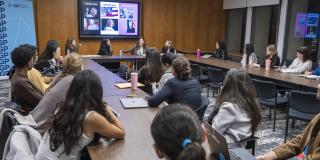
On November 5, the Institute of Global Politics (IGP) Women’s Initiative hosted “Perceptions of Women Leaders: A Front Row View,” featuring Azza Cohen, former official videographer and director of video to Vice President Kamala Harris, and Opal Vadhan, former aide to Vice President Harris and Secretary Hillary Rodham Clinton. Rachel Vogelstein, IGP Women’s Initiative co-director and associate professor of professional practice at Columbia SIPA, and Jennifer Klein, IGP Women’s Initiative co-director and professor of professional practice, joined Cohen and Vadhan in the conversation. This was the second roundtable in the social norms roundtable series, following “A Conversation about Changing Gender Norms” with Tresa Undem, cofounder and partner of PerryUndem and gender equity public opinion expert.
The discussion gave students a behind-the-scenes look at the work of women who have broken some of the greatest barriers in US politics. Both Cohen and Vadhan reflected in detail on their experiences working for trailblazing female political leaders.
Cohen spoke at length about the importance of visual representation in shaping public perceptions of women in power, explaining that media depictions too often subtly undermine their authority through sexist visual framing.
This phenomenon – what Cohen calls “visual sexism” – occurs when seemingly neutral photographers and videographers portray women in ways that undercut their authority and detract from how audiences view their leadership. Cohen marshalled examples that have affected women of all political stripes, from former Vice Presidential candidate Governor Sarah Palin to Boston Mayor Michelle Wu. “Feminist framing,” by contrast, counters visual sexism by depicting women on the same visual and symbolic level as men. Such framing is critically important, Cohen concluded, because “something as simple as a camera angle can convey power or diminish it.”
The panelists also addressed broader systemic challenges to women’s equality in politics. Both speakers noted that while women’s representation in elected office has increased globally, so too has online harassment and abuse. Cohen pointed to the rise of deepfakes and AI-generated misinformation, noting that “AI is trained on the internet, which is a notoriously nasty place for women.” Vadhan emphasized the responsibility individuals have to intervene: “There’s no one fact-checking the internet,” she said. “If you see something false or sexist, call it out.”
Students engaged actively in the Q&A session, asking about topics ranging from double standards in politics to authenticity in public image. Vadhan encouraged students to pursue careers in public service, and urged women especially to remain “supportive of each other along the way.”
Through candid reflection and expert insight, the conversation illuminated how representation and framing continue to shape perceptions of women's leadership – and how the next generation of women leaders can play a role in changing those narratives for the better.